Family Issues and Arab Identity Top Agenda of International Year of the Family Conference
Her Highness Sheikha Moza bint Nasser, Chairperson of Qatar Foundation for Education, Science and Community Development, today witnessed the opening of the 30th Anniversary of the International Year of the Family Conference, under the theme "Families and Mega-Trends...

Her Highness Sheikha Moza bint Nasser, Chairperson of Qatar Foundation for Education, Science and Community Development, witnessed today the opening of the 30th Anniversary International Year of the Family Conference, entitled "The Family and Contemporary Mega-Trends," at the Qatar National Convention Centre. The conference was attended by a number of prominent figures, including President Vjosa Osmani-Sadriu, President of the Republic of Kosovo, President Dr. Hussein Ali Mwinyi, President of Zanzibar, and Her Excellency Ms. Amina Mohammed, Deputy Secretary-General of the United Nations, in addition to a group of sheikhs, ministers and officials.
In her opening speech, Her Highness affirmed the great similarity between the challenges facing families around the world, despite the different specificities from one country to another. Her Highness mentioned that among the most prominent challenges facing families today are technological changes and their impact on the mother tongue and the conflict of identity, noting that these challenges require cultural, economic and development efforts from countries to confront them and reduce their effects.
Source: Doha International Family Institute
The Arab Family Facing the Challenges of Technology and Language
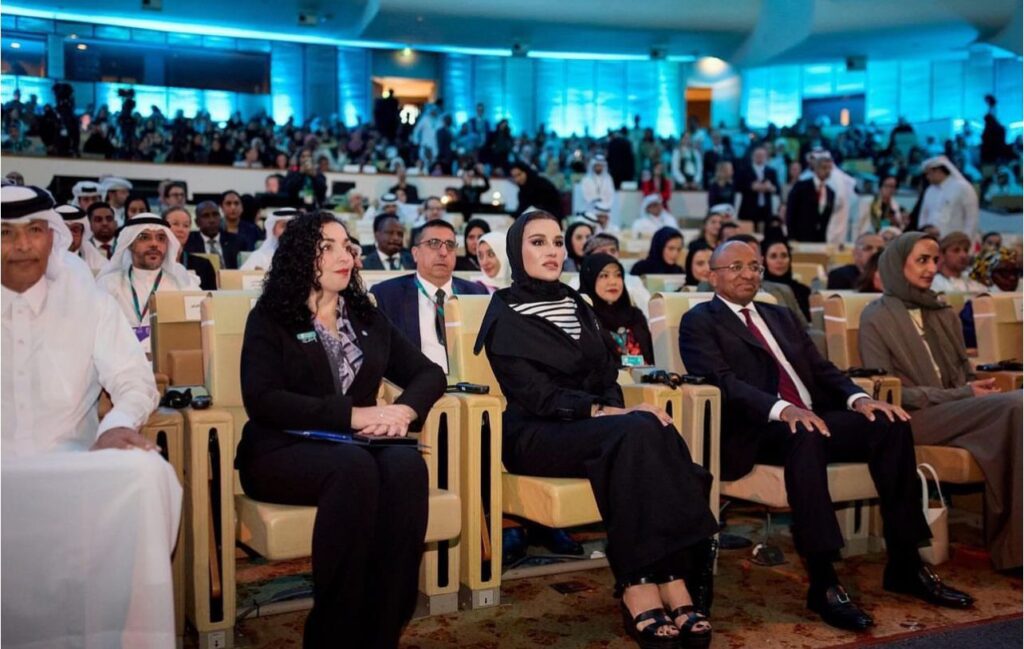
In a spirit of pride and concern, Her Highness highlighted the challenges facing Arab families, most notably the increasing effects of technology on values and social relations. She added: "Our consumption of digital technology without awareness takes us away from reality and into a virtual world, which enhances cultural alienation, especially among the younger generations, which sometimes makes them distant from their language and identity."
The Struggle of Identity and Mother Tongue in Light of Globalization
Her Highness pointed to another challenge, which is the need to defend the status of the Arabic language, as it is the essence of identity and the carrier of the cultural and value heritage of the Arab nation. She stressed the importance of preserving the mother tongue without turning away from it, saying: "The Arabic language is us, and without it we lose our identity." Her Highness criticized the widespread use of English among Arab youth in their daily communication, considering this a danger to their connection to their culture and Arab roots.
Gaza: A Steadfast Identity and Education that Enhances the Strength of Generations
In the context of her talk about the challenges facing the Arab nation, Her Highness cited the steadfastness of the people of Gaza, noting that this steadfastness stems from the religious and national awareness that the family instills in the souls of its children, stressing that family education that enhances identity and belonging plays a crucial role in preparing a generation aware of its roots and responsibilities.
In conclusion, Her Highness expressed her hope that this conference will contribute to achieving practical results that contribute to enhancing the protection of the family and the development of society.
Family Values and Their Role in Strengthening Social Cohesion in Qatar
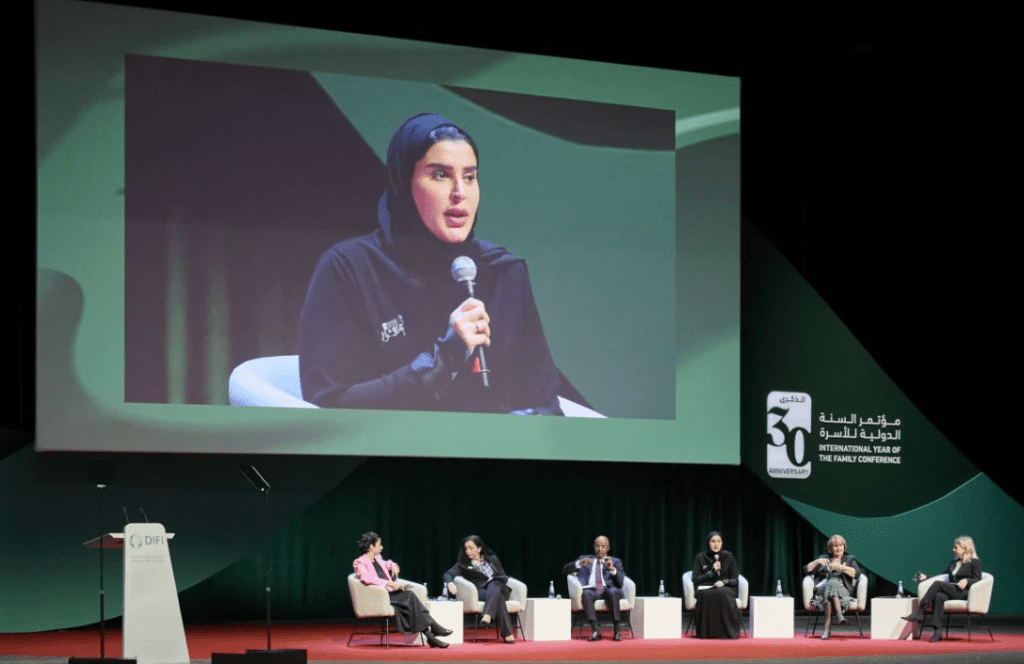
For her part, Her Excellency Ms. Mariam bint Ali bin Nasser Al-Misnad, Minister of Social Development and Family, affirmed that the State of Qatar places family values before its eyes when formulating its policies, so when the Third National Development Strategy was developed, family policies were among its most important pillars, in addition to many existing laws such as the Compulsory Education Law, the Family Law, as well as many social and family services available.
Her Excellency pointed to the launch of the Ethical Charter for the Family at the beginning of last August, which contains many family values and reflects the family values adopted by the State of Qatar, such as honesty, trustworthiness, cooperation, solidarity, dialogue, and also mutual respect, pointing to the awareness of successful previous civilizations that lasted for centuries, of the value and importance of the family, and its reliance on a set of values and laws, the first of which are family values.
Her Excellency the Minister of Social Development and Family explained that the work focuses on ensuring the existence of a cohesive and effective family in society, because if it is, it will be the basis for the success of society in general, in addition to strengthening the spirit of responsibility among individuals, because the absence of a spirit of responsibility and the tendency towards individualism may cause the absence of a focus on the public interest of society and the focus on individual interest, and she said in this context, "Therefore, we must take honest and serious steps towards identifying the causes of these phenomena."
In her speech, Her Excellency Ms. Mariam bint Ali bin Nasser Al-Misnad pointed to the importance of spreading awareness about the functions of social units in Qatari society, such as the tribe, family, religion, and identity, because awareness of these different social "units" ensures that the Qatari individual has a sound awareness of how to deal with these units, in addition to the continuous review of the objectivity of legislation related to social affairs to study their economic, educational, psychological and social effects and consequences in order to reach the best legislation that ensures keeping pace with and confronting challenges.
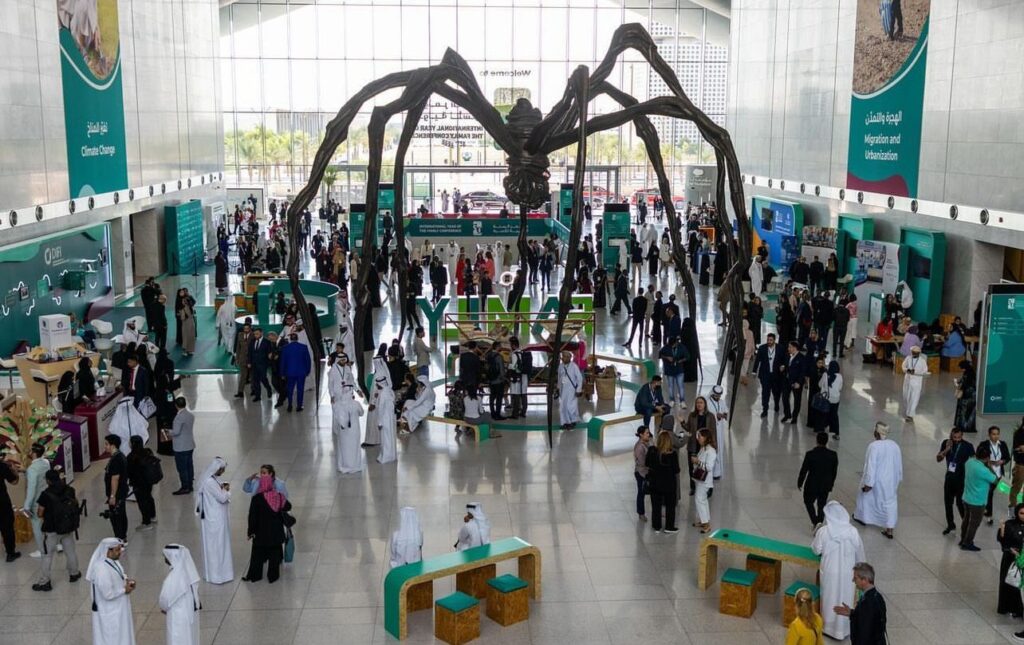
It is worth mentioning that the conference, organized by the Doha International Family Institute in cooperation with several partners, will last for two days, during which the main issues and challenges facing the family in light of modern changes, such as technology, demographic changes, migration, urbanization and climate change, will be discussed, with the wide participation of regional and international institutions, civil society organizations, experts and decision-makers from around the world.
Comments (0)
Add Your Comment
No comments yet. Be the first to comment!